


I had dreamed for nearly 20 years of climbing to the top of Ayers Rock and watching the sun set over the desolate plain that lies to its west. I knew that a bus ride (longer than two days) from Sydney was out of the question. I visited the American Express bureau downtown and booked a ticket for the three-and-a-half hour flight.
There are some benefits to having explored the world in a less conscientious time. As you’ll learn in the next section (Europe) of this memoir, the first time I visited Athens I was allowed to climb among the ruins of the Parthenon. Try doing that now. I am also old enough to have visited Alice Springs when visitors could still climb to the top of Ayers Rock.
About that name … The sandstone monolith now known as Uluru, originally named by the local Anangu people in their own language, was called “Ayers Rock” by explorer William Gosse in 1873 to honor Sir Henry Ayers, the Chief Secretary of South Australia. In 1993, a dual naming policy officially designated the landmark as “Ayers Rock / Uluru,” reflecting both its Aboriginal and colonial names. In 2002 the order was reversed to “Uluru / Ayers Rock” to honor traditional ownership. The climbing of Uluru, long discouraged by the Anangu due to its sacred significance, was formally banned on October 26, 2019. Unlike many indigenous place names, the word “Uluru” does not carry a second meaning.
I took the taxi from the Alice Springs airport into the tiny heart of the town, which boasted a population of around 20,000 in the early 1990s. Of those 20,000 about 20 percent were of Aboriginal descent, most of whom lived in nearby outstations or town camps. The driver dropped me off on Todd Mall, the main drag, home to restaurants, shops, bars, and a few bedraggled hotels. The source of that name is pretty straight forward: The Todd Mall was originally called Todd Street because it was close to the Todd River, which was named for Alice Todd, the wife of Sir Charles, the Superintendent of Telegraphs in the late 1800s. Sir Charles was instrumental for connecting Alice Springs to the rest of the world via telegraph. As you might guess, Alice is the main reason the town is called Alice Springs.
The manager of one of those scruffy hotels gratefully accepted my cash and then sent me past the front desk toward the rear of the building. He told me to keep walking until I ran into a door. Head on a swivel, I inched down a long, dark hallway covered in bare plywood walls. Upon check-in I was given two keys - one a skeleton key to open the room’s front door; the second, a key to lock/unlock a padlock that provided security inside the room via a thin, metal latch. A normal person might have been given pause by the need for two locks, but hey, I slept in a lean-to in an African jungle for nearly a month so no need to worry here.
I dropped my bag on the bed and headed out. I wanted to find a meal and then a bar, not necessarily in that order. I was eager to see Aboriginal Australians up close, not just in film or old copies of National Geographic. As frequent readers know, I spent part of my formative years in southern Arizona, where I went to school, fought, laughed, and played sports with Navajo kids. My head was unfilled with politically correct nonsense about the Noble Savage. Indigenous people offer cultural insights that simply confound Western ways of thinking and living but they still are governed like you and me by the same selfish hungers and tribal instincts as the rest of us. My fascination with the locals was driven by one feature of their culture: The Aboriginal concept of “walkabout.”
Walkabout is a traditional Aboriginal Australian rite of passage, primarily undertaken by adolescent males, in which they embark on a solo journey into the bush for several months to live off the land and follow ancestral “songlines. “This practice is both physically and spiritually demanding, serving as a test of survival skills and marking the transition to adulthood. During walkabout, the young person connects deeply with their heritage and navigates the land using these songlines, which map out geographical and spiritual landmarks. It is a sacred act that fosters responsibility, strengthens cultural identity, and ensures the continuation of stories and traditions from one generation to the next.
A “songline” is defined by Perplexity as an Aboriginal concept describing a “pathway across land or sky that traces the journeys of ancestral Creator Spirits in the Dreaming, encoding routes, cultural knowledge, and law through songs, stories, and rituals.” My favorite travel writer, Bruce Chatwin, published a wistful book called Songlines in 1987. I had also been inspired by the film Walkabout, a 1971 movie by Australian director Peter Weir, which tells the story of two city-bred siblings stranded in the Outback, where they learn to survive with the aid of an Aboriginal boy on his “walkabout.” It is a starkly beautiful film made uncomfortably sensual by the performance of the British actress Jenny Agguter, who was 16 at the time of the shooting.
I wanted my own walkabout experience, which I intended to get a few days later when I joined a multi-day camping tour that would take me to the summit of Ayers Rock and later to an awe-inspiring visit to the Olgas. There was also an ulterior motive to my Outback visit. I knew that Livvy was a secure communications officer for the Australian military, which co-hosted with the U.S. a military facility at Pine Gap, about 15 miles away from Alice Springs. She implied during our escapades in Europe that she worked at a facility that barracked American soldiers.
Despite the proximity, I had no intention of showing up at the heavily fortified front gate of Pine Gap because the conversation would probably not go well.
Me: “Can you take a look at this photo from around 15 years ago,” I said, showing the heavily armed guards a well-worn snapshot of Livvy in a white bikini. “I used to date this Australian communications specialist by the name of Olivia. Does she still work here?”
Their answer is muffled by the sound of gunfire and me screaming.
Folks under the age of 40 have no idea how hard it was in the old days to find an old girlfriend even if you were a highly skilled investigative reporter and intrepid stalker. There were few mobile phones, no Internet to speak of, and no social media. In fact, the first social media platform, a dinosaur called Six Degrees (as in six degrees of Kevin Bacon), wouldn’t launch until the late 1990s. Since Australia had such a small population I assumed I was only about three degrees of separation away from Livvy.
I convinced myself that some of the soldiers taking a break in Alice Springs would know Livvy (she was that good looking) so I would work the bars in Alice Springs. I had extensive plans for continued bar investigation when I arrived later in Adelaide, the home of Stephen and the Peters, my drinking buddies.
I ate a meal of french fries and kangaroo burger (“I hope that was your grandma”) in a dusty dive bar that would have looked at home in the American West of yore. The locals heard me order my food and drink and immediately began muttering about “Yankee wanker.” This is a derogatory term that refers to an obnoxious person, or better yet, a person who, uhm, touches themselves with great vigor. A couple of the boys decided to do some investigating of their own and plopped down on chairs at my table.
I resorted to my favorite (only?) diplomatic strategy and ordered a round of beers, Foster’s Lager, of course. And then another. And another. By the end of the night we were best friends. They vowed to help me find Livvy, but only after I showed them the bikini photo of her about 15 times. We agreed to meet at the bar the following afternoon to launch a pub crawl in our attempt to track down military types who might know her. I staggered back to my dimly lit room, locking the inner padlock for safety before crashing onto the hard mattress covered only by a faded blanket that matched the flocked wallpaper peeling from every corner.
The next morning I woke with a grade six headache (on a scale of 1-10). Before heading out the door I first I had to engage in a ritual ablution the Australians crudely but efficiently labeled the “four S’s,” as in shower, shave, shag, and shit. I completed three of the S’s but was unable to complete the fourth, shag, because that was slang for having sex, and I had promised to be a good boy on this trip. Forty years later, I still call my morning ritual the three S’s.
I had read that the folks in the Outback were fond of a traditional breakfast called the “Big Fry,” not unlike the British breakfast I had eaten at multiple London bed and breakfasts near Bloomsbury Square, my stomping grounds since the 1970s. The Australian meal featured simple fare, including eggs, bacon, grilled tomatoes, mushrooms, and toast slathered with Vegemite.
We must pause here to lament the faulty taste buds of the typical Australian. Vegemite is a spread made primarily from leftover brewer’s yeast extract and mixed with salt, malt, and vegetable extracts. I am sure there is a heavy dose of industrial waste added for good measure. This is how foul I believe Vegemite to be: I would rather eat a witchetty grub than let that vile condiment defile my digestive system. What is a witchetty grub, which I did indeed eat, you might ask? It is a large, white, pulsating larva of several wood-eating moth species that Australians, once again inexplicably, eat raw or lightly roasted over coals. Grubs for grub.
I spent the day shopping for travel knicknacks, including a boomerang I couldn’t wait to give to my nephew in the hopes that he would drive my sister and brother-in-law insane by throwing it around their cluttered living room. I thought it would be a good match for the curved dagger I bought him in the Grand Bazaar in Istanbul. As you can surmise, this is why I am everyone’s favorite uncle.
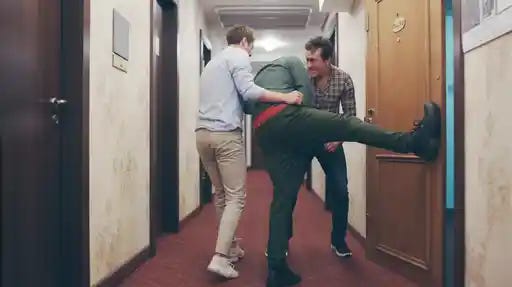
There is not a lot to do in Alice Springs besides drink. So I drank four beers during my lunch and headed back to my room for a nap, once again padlocking the inside door. A few hours later I was awakened by shouts of “Where is the fucking Yankee wanker?” from the tiny lobby of the hotel. My drinking buddies from the night before had come to collect me. I pretended to be asleep and didn’t respond, but that strategy failed when they located my room at the end of the hall and kicked in the door, ejecting the latch and lock from its tenuous hold on the sill. I guess I was going to the bar after all.
I made a show of matching them beer for beer but then begged off around midnight because I was scheduled to leave early the next morning for a four-day camping trip to Ayers Rock and the Olgas. We had visited four pubs, located a few servicemen, all Australian, but none of them knew Livvy. Now I was eager to move on. The tour company had told me to join the group at 7 a.m. at a bench in front of the tall gum tree that marked Todd Mall and the eponymous store at its center. After a few hours of sleep and a tepid shower, I paid my hotel bill, which now included the replacement cost of the lock and latch, and walked over to the bench.
A group of rough and tumble campers, all women, hooted when I walked up. Apparently, I was the only man in a group outing booked under the title of the Lesbian Hiking Club. Readers are well aware of my success with women, but this was going to be a challenge.
Author’s note: This is the third entry in the section of my travel memoir that focuses on escapades in Australia. It follows the completion of part 1, called Interesting Ways to Die … in Africa, and part 2, Interesting Ways to Die … in South America. As usual, I will release new entries on a weekly basis until this section is finished. Read individual entries for the Australian section: #1 and #2.