

AI Isn’t Killing Professional Development — It’s Killing the Information Business
As generative AI commoditizes content delivery, the K-12 PD market is shifting away from fly-in experts and toward trust, simulation, and job-embedded coaching.

TL;DR - Key Ideas
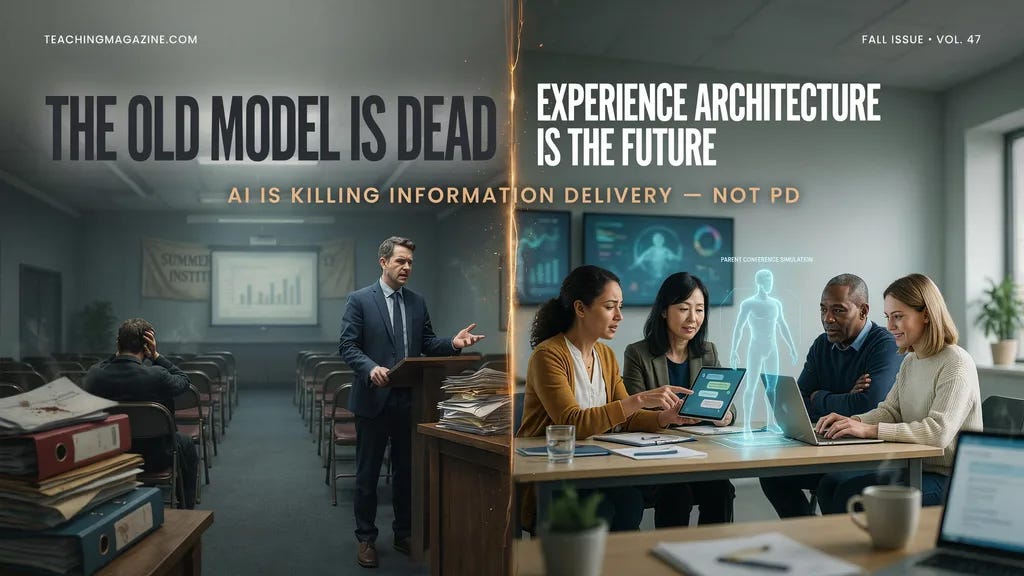
AI is Killing Information Delivery, Not PD: Generative AI has commoditized “know-what” and “know-how” by instantaneously delivering customized, standards-aligned content and 24/7 coaching, forcing a shift away from traditional, information-heavy workshops.
District Spending Shifts to Hybrid and Digital Models: Post-pandemic substitute teacher shortages and expiring ESSER relief funds have drastically curtailed multi-day, off-site face-to-face (F2F) conferences in favor of asynchronous digital learning, tech implementation, and job-embedded training.
Effective Learning Requires a Human-First Kickoff: Grounded in adult learning theory, sustainable professional development relies on intensive in-person launches to establish norms, build trust, and model complex practices before transitioning to online PLCs for ongoing support.
The Rise of AI Simulations for Low-Stakes Practice: Immersive, voice-enabled AI simulation platforms are changing skill rehearsal, allowing teachers to practice high-friction scenarios—like managing PBL critique sessions or tough parent conferences—with immediate feedback.
The Future Belongs to “Experience Architects”: Successful professional development providers must pivot from selling generic lectures to designing integrated ecosystems—combining proprietary custom AI agents and simulation tools with high-touch, trust-building human facilitation.
In education, summer does not end with Labor Day. It ends when teachers report for duty.
For many of my friends and colleagues, the opening of school also brings the professional-development season to an abrupt halt.
Folks in my line of work make the majority of their income in the summer months, when teachers on the traditional calendar have time to attend workshops, conferences, lectures, and presentations. When I was the Senior Director for the Buck Institute for Education, we would earn between 75-80 percent of our annual revenue during June, July, and August.
This familiar cycle of boom and bust has been disrupted by two seismic events in the last six years. COVID-19 demolished the market for face-to-face (F2F) professional development and sent many of my colleagues into the unemployment line. Two years later, Chat GPT did something potentially more consequential: it began eroding the value of professional development built primarily around the delivery of information.
My colleagues often complain about the lack of business, then invariably ask me to predict what will happen to the market over the next decade. I know that COVID forced teachers and professional development providers onto online learning platforms. That is a change that can be managed, even though it signals a rapid decline in earned income for PD providers who charge higher fees for face-to-face encounters. But what of generative AI’s impact on professional development?
I now have an idea how to answer that question after spending a week interviewing folks in my network and the leaders in school systems who make purchasing decisions. During my research, I looked at patterns in school budgets. Finally, I examined the technology itself and asked what it can now do that once required a paid expert.
Here is the thesis that has emerged: AI is not killing professional development. It is killing professional development whose main product is information.
PD Spending Survived. The Old Model Did Not
The financial picture is more complicated than the complaints suggest. Districts have not stopped spending on professional learning. They have changed what they buy. While the anticipated collapse of face-to-face professional development funding hasn’t manifested as a uniform downward slide, the nature, delivery model, and structural financing of PD have shifted dramatically since 2020.
Contrary to assumptions that districts drastically slashed overall PD budgets, multi-year analyses — such as data from the Research Partnership for Professional Learning (RPPL) — indicate that district spending on teacher professional learning has largely kept pace with overall education budgets.
However, looking strictly at flat or slightly increased nominal spending masks critical delivery shifts. The two most prominent of these are:
1) As federal relief funds (ESSER) sunset, districts faced intense budget compression. While many core PD lines survived, approximately 25% of district leaders report scaling back or anticipating reductions.
2) While total dollars have remained relatively steady, the allocation toward face-to-face delivery — specifically out-of-district conferences, regional workshops, and multi-day off-site symposiums — saw a massive contraction during the pandemic that has only partially rebounded.
The transformation of face-to-face professional development is tied to several converging economic, operational, and technological pressures, most notably, the severe substitute teacher shortage and labor market constraints, the rise of generative AI and digital infrastructure shifts, and the demand for high-return, job-embedded formats. Let’s examine these one by one.
When I shifted the Buck Institute for Education (now PBLWorks) model for its PBL 101 workshop from a two-day to a three-day structure, I faced tremendous criticism based on one valid complaint: districts and schools, especially those in rural and urban areas, simply could not locate enough subs to cover classrooms for three consecutive days. Since then, the post-pandemic labor market tightness exacerbated K-12 staffing.
Because sub-shortages and rising operational costs made classroom coverage a logistical nightmare, districts heavily deprioritized off-site, pull-out F2F workshops in favor of asynchronous digital modules, job-embedded coaching, or after-hours virtual training.
The rapid proliferation of generative AI tools starting in late 2022 forced an abrupt pivot in district technology priorities. Concurrently, the massive hardware influx initiated during 2020 remote learning needed continuous software integration. Districts faced an urgent mandate to train educators on AI literacy, digital ethics, and administrative efficiency tools.
Because generative AI moves at a breakneck pace, traditional F2F PD models — which take months to plan, review, and contract — proved too sluggish. Districts increasingly turned to rapid-response, software-embedded micro-learning, vendor-provided digital webinars, and AI-driven platforms.
Consequently, a slice of the training budget that traditionally went toward generic pedagogical F2F workshops was redirected toward tech implementation and digital licenses, re-enforcing the power of AI to reshape the marketplace.
A Hybrid Model for Reshaping PD
My business card at the Buck Institute used to read “Senior Director,” but my real job was more aligned to what folks in the industry call Chief Program Officer. I was tasked with charting a multiyear developmental arc for our services. My last year at BIE was 2015, but I could already see that online learning would evolve from an upstart challenger to the dominant delivery system it is today.
It was my belief then and it remains my belief today that all effective professional development that focuses on enduring changes in teacher practice must be ongoing. The process must be anchored in an initial face-to-face learning experience in order for ongoing (and price aware) support to be effective in an online relationship.
My instructional support philosophy is grounded both in research and in three decades of delivering professional development.
Studies evaluating hybrid teacher training models point to structural advantages when face-to-face sessions precede digital components: Complex pedagogical frameworks (such as project-based learning design) often involve steep learning curves. Initial in-person workshops allow trainers to model complex practices, observe participants at work, and troubleshoot problems immediately.
Face-to-face kickoffs allow cohorts to establish group norms, cooperative protocols, and working agreements. When the cohort transitions to online spaces, those structural norms carry over, keeping engagement rates higher and dropout rates lower than in purely online, self-paced courses where participants feel anonymous.
Malcolm Knowles’ principles of adult learning emphasize that adults are heavily self-directed, practical, and motivated by immediate relevance. An intensive F2F launch grounds the professional development in an immersive, collaborative environment where teachers can immediately map the concepts to their local classroom realities.
The subsequent online phase then functions not as an abstract set of digital assignments, but as an ongoing support network (or job-embedded PLC) designed to troubleshoot the real-time application of what was initiated during the face-to-face workshop.
Final Thoughts
After decades spent mastering the nuances of PBL and tech integration, watching the traditional marketplace for F2F PD shift under the weight of AI-driven platforms can feel like watching the ground move beneath your feet.
My colleagues’ complaints are well-founded: the old model — where a district flies in a renowned expert for a glossy, multi-day seminar — is facing structural obsolescence.
However, the future is not a complete erasure of human-led F2F learning; rather, it is a bifurcation of the market. Generative AI, autonomous agents, and immersive simulations are redefining what can be done asynchronously at scale, which simultaneously changes the entire value proposition of in-person human interaction.
Here is how I see the landscape of professional development is evolving under the pressure of AI agents, simulations, and intelligent companions:
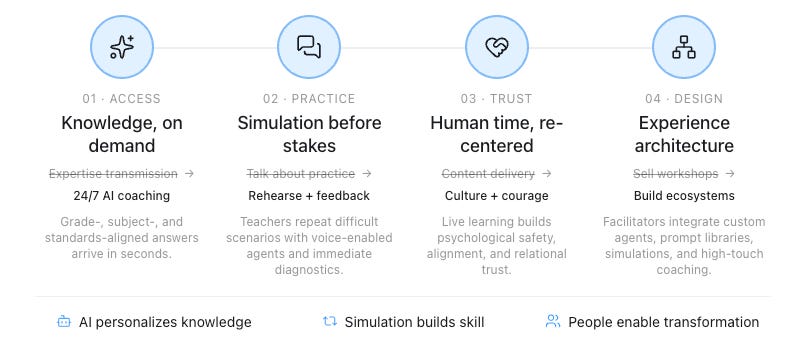
1. The commoditization of “know-what” and “know-how:”
For years, a large portion of PD budgets paid for expertise transmission. AI agents and customized learning companions can now deliver this information instantaneously, customized to a teacher’s specific grade level, subject area, and state standards in seconds. Furthermore, AI-powered pedagogical coaches can act as 24/7 thought partners, answering granular curriculum design questions without a human consultant present.
2. The rise of AI-powered simulations for skill rehearsal: One of the hardest things to do in traditional F2F PD is to practice complex, high-friction pedagogical moves — such as facilitating a student-centered inquiry circle, managing pushback during a PBL critique session, or navigating an emotionally charged parent-teacher conference. We are entering an era where immersive simulation platforms powered by voice-enabled AI agents allow educators to rehearse these scenarios repeatedly through low-stakes practice loops with immediate diagnostic feedback.
3. The re-centering of F2F PD around trust: If AI agents can handle content delivery, resource generation, and baseline skill simulation, what is left for face-to-face professional development? The messy, deeply human architecture of transformation. High-stakes pedagogical shifts — like moving a traditional school culture toward agency-based, project-based learning — require psychological safety, cultural alignment, and deep relational trust.
4. The evolution of the professional developer role: For veterans who have spent decades perfecting their craft, survival and prosperity in this new ecosystem will require a pivot from content delivery to experience architecture. Successful PD providers will stop selling workshops and start designing integrated ecosystems. They will build proprietary custom AI agents, prompt libraries, and simulation scenarios tailored to their specific pedagogical frameworks, licensing them alongside high-impact, high-touch facilitation.
The business of F2F PD is indeed contracting in its traditional, transactional forms. Districts will no longer pay top dollar for a human to stand at a podium and lecture on tech integration that an AI agent can explain in a chat. However, the future belongs to those who leverage AI to handle the cognitive heavy lifting of resource creation and simulation-based practice, freeing up live, face-to-face time to do what machines never can: build deep professional trust, foster institutional courage, and anchor educators in a shared, human community of practice.
Is AI going to replace human professional development providers and consultants?
AI is not replacing human professional developers, but it is rendering “information-delivery” workshops obsolete. AI agents and customized learning companions can now handle content generation, standards mapping, and basic curriculum design in seconds. What AI cannot replicate is the deeply human architecture of organizational transformation—building psychological safety, establishing relational trust, and fostering institutional courage during high-stakes pedagogical shifts. Successful educational consultants will pivot from content deliverers to “experience architects,” leveraging proprietary AI tools alongside high-touch human facilitation.
Why are school districts cutting back on multi-day, face-to-face PD workshops?
The pull-back from multi-day, off-site workshops isn’t driven solely by shrinking budgets; it is a convergence of operational, financial, and technological pressures. Severe post-pandemic substitute teacher shortages make covering classrooms for consecutive days a logistical nightmare for administrators. Additionally, as ESSER relief funds sunset and technology moves at a breakneck pace, districts are deprioritizing slow-to-contract, traditional F2F seminars in favor of software-embedded micro-learning, job-embedded coaching, and agile digital training that doesn’t disrupt daily classroom coverage.
How can school and district leaders design an effective hybrid PD model that actually changes teacher practice?
Research and adult learning theory show that sustainable professional development requires an intensive face-to-face launch before transitioning to digital spaces. In-person kickoffs allow facilitators to model complex practices, troubleshoot in real-time, and establish cohort working agreements that keep engagement high. Once that relational foundation is set, the online phase functions not as passive coursework, but as an active, ongoing professional learning community (PLC) where teachers receive continuous support while applying new strategies in their classrooms.
What are AI-powered simulations, and how do they impact classroom instruction?
AI-powered simulations use voice-enabled AI agents to create low-stakes, immersive practice environments where educators can rehearse high-friction instructional moves. Instead of practicing complex scenarios on live students, teachers can repeatedly rehearse facilitating student-led inquiry circles, navigating difficult parent-teacher conferences, or managing critique sessions. These platforms provide immediate diagnostic feedback, allowing teachers to refine their questioning, behavioral management, and pedagogical moves before executing them in front of an actual classroom.
How should district procurement policies adjust to AI-driven professional learning tools?
District leaders must update their procurement frameworks to evaluate tech tools based on job-embedded utility rather than static content delivery. Instead of allocating line items strictly to traditional out-of-district conference registrations or generic pedagogical speakers, policy should support software-embedded digital licenses, AI-driven coaching companions, and hybrid facilitation packages. Procurement policies must prioritize platforms that ensure data privacy while offering rapid-response, standards-aligned micro-learning that integrates directly into teachers’ daily workflows.
This work is licensed under a Creative Commons Attribution 4.0 International License (CC BY 4.0). You are free to share and adapt this material with attribution.