
How Teachers Can Use AI-Generated Fables to Teach Complex Concepts
Across disciplines, generative AI can help students transform abstract ideas into memorable narratives that deepen comprehension, strengthen critical thinking, and improve conceptual understanding.

TL;DR — Key Ideas
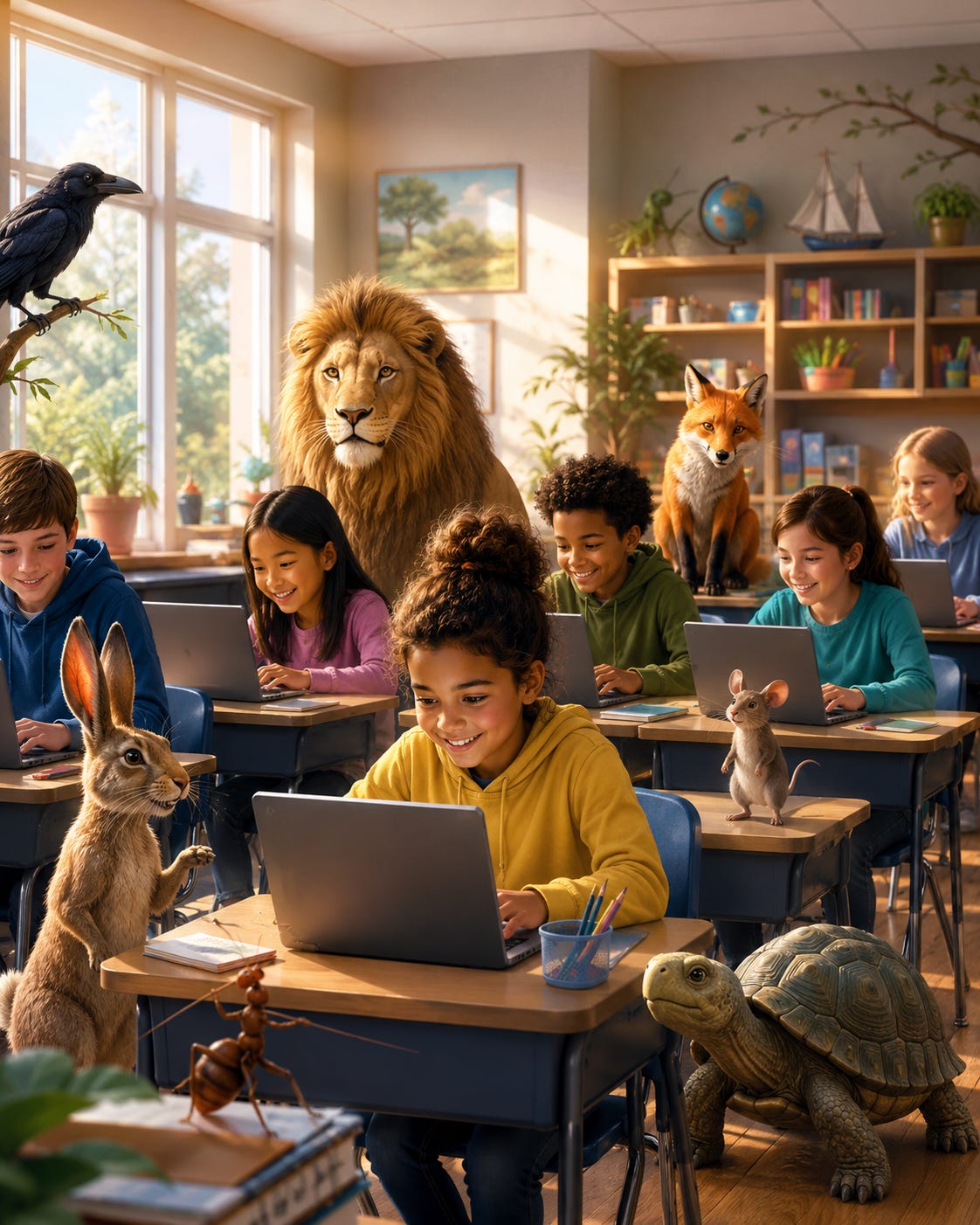
Generative AI can help students understand complex academic concepts by transforming them into fables, allegories, and narrative structures that improve comprehension and retention.
AI-generated storytelling activities strengthen higher-order thinking skills because students must analyze, revise, critique, and map abstract concepts onto symbolic narratives.
Teachers can use tools like ChatGPT, Claude, Gemini, and Copilot to create classroom-ready fables in math, science, language arts, and social studies.
The instructional value of AI storytelling lies less in the generated prose and more in the cognitive work students perform while interpreting and revising the narrative.
Different large language models exhibit distinct storytelling tendencies: Claude emphasizes cognitive depth, Gemini favors explanatory clarity, Copilot leans toward moral instruction, and ChatGPT produces highly teachable classroom frameworks.
If you skim the offerings on Substack from the dozen or so education writers who specialize in deconstructing AI research and policy, you will notice how heavily we rely on metaphor and analogy.
I will include myself among the usual suspects and gladly accept the accusation.
In the near future, though, I plan to borrow an arrow from the quiver of Amanda Askell, Anthropic’s in-house philosopher. She recently shared a prompt she uses to explore whatever academic field she’s curious about that week.
Instead of asking a large-language model (in her case Claude) to explain a concept, she suggests that we ask the AI to write a fable that embodies the concept, with the reveal saved for the end. This taps into a well-established cognitive principle: narrative can be a highly effective mode of instruction.
By withholding the concept label until the end, the reader is required to infer meaning from patterns, relationships, and consequences rather than memorize a definition upfront.
In this blog I will share the prompt I used to mimic Askell’s process, convey the results of my experiments, and then make suggestions for how teachers and students can adapt it to create compelling narratives that improve comprehension of complex ideas.
My Prompt, My Way
Why fables? Fables have remained a popular genre because they are short, easy to remember, and deliver a clear moral lesson in an entertaining way. Their animal characters and simple plots helped them endure as both teaching tools and stories people enjoy retelling. They usually end with a clear takeaway, making the message easy to remember.
I took Askell’s prompt and minimally adapted it into the following:
“Use the concept of cognitive offloading at about the graduate-student level from the field of education. Explain this concept through a fable without naming it directly until the end. Structure it so that only toward the very end do readers gradually realize what the concept actually is. After the story, add a section that clearly articulates the concept you just conveyed.”
I chose an oft-used term (cognitive offloading) making the rounds in articles that focus on the widespread student use of AI tools to to complete higher-order cognitive tasks associated with Bloom’s Taxonomy.
The prompt was fed into the four major LLMs (Claude, Gemini, Copilot, ChatGPT). I copied their responses and pasted them unedited into a Google doc. You can review the outputs here.
Looking for Patterns
Fables are a formulaic genre that usually follow a simple pattern: a brief conflict involving clearly drawn characters, often animals with human traits, ends with a clear lesson or moral. The structure is straightforward and memorable, which helps the story’s message stand out. (Note: to clarify definitions, fables are a subset of allegory.)
With that knowledge in hand, I first reviewed the four outputs to see if the LLMs used the classic form of this genre. They did. I then looked for additional patterns, among them characterization, plot, setting, and narrative sequencing. This part was fun because it reminded me why I majored in Comparative Literature as an undergraduate and American Literature in graduate school all those decades ago.
Claude and ChatGPT rely on relational dynamics between the main characters, allowing characters to embody competing approaches to thinking. Gemini and Copilot, by contrast, use more symbolic or collective figures, where characters function less as individuals and more as representations of a single idea or cautionary principle.
The four stories share a common underlying arc but differ in how they handle tension and resolution. Across all four, the narrative arc hinges on the same insight: external supports change how thinking operates.
Narratively, the outputs span a spectrum from literary to instructional, but all employ allegory to gradually surface a complex cognitive concept. All four rely on delayed conceptual revelation to some degree, guiding the reader from concrete actions (writing, weaving, using tools, etc.) toward an abstract realization about thinking.
How to Use Fables in Your Classroom
My initial assumption was to view fable writing as a strategy for teachers. I realized upon further reading that it can be flipped by tasking students with the responsibility of using AI tools to create fables that help them and their peers understand complex ideas.
The power here is not in the story itself, but in the thinking required to encode a concept into narrative form. When students ask AI to produce a fable, critique it, and revise it, they must identify the underlying structure of the concept in a way that traditional explanations rarely demand.
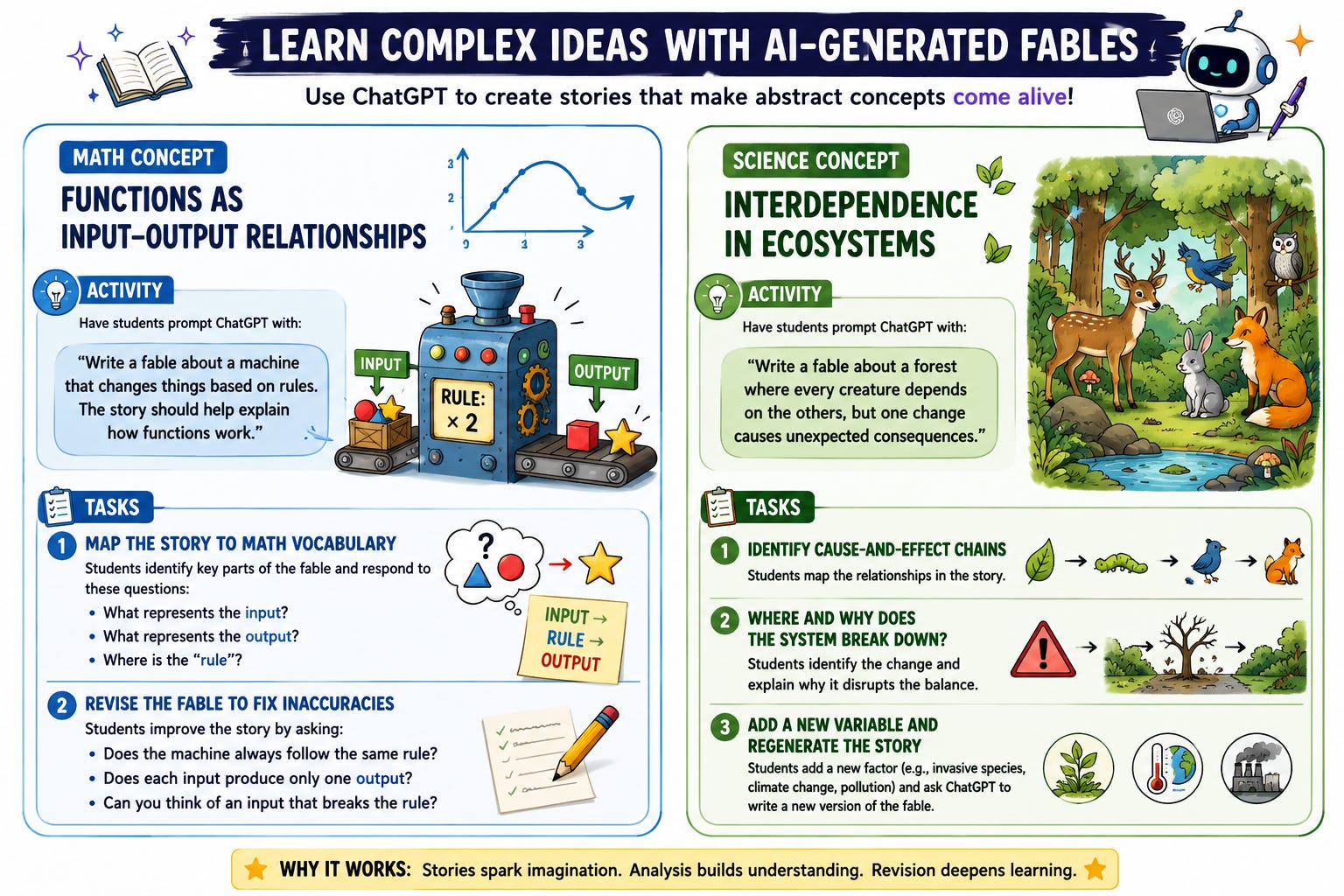
Here are a few ways this approach could work across core subject areas:
Math Concept: Functions as input-output relationships
Activity: Have students prompt an AI with:
“Write a fable about a machine that changes things based on rules. The story should help explain how functions work.”
Tasks:
Students map parts of the story to math vocabulary and respond to questions: What represents the input? What represents the output? Where is the “rule”?
Students revise the fable to fix inaccuracies, using guiding questions such as: Does the machine always follow the same rule? Does each input produce only one output?
Science Concept: Interdependence in ecosystems
Activity: Have students prompt an AI with:
“Write a fable about a forest where every creature depends on the others, but one change causes unexpected consequences.”
Tasks:
Students identify cause-and-effect chains in the story.
Students identify where and why the system breaks down?
Students add a new variable (e.g., invasive species, climate change) and regenerate the story.
Language Arts Concept: Theme and symbolism
Activity: Have students prompt an AI with:
“Write a fable about a character who takes shortcuts and faces consequences, but don’t state the moral directly.”
Tasks:
Students identify the implied theme.
Students revise the story in order to strengthen symbolism and remove overly explicit moralizing.
Students compare multiple AI-generated versions by responding to the questions: Which one is most effective? Why?
Social Studies Concept: Balance of power / rise of authoritarianism
Activity: Have students prompt an AI with:
“Write a fable about a village where one leader gradually gains more control, and the villagers don’t notice until it’s too late.”
Tasks:
Students connect elements of the story to real historical examples by answering questions such as: Who represents institutions? What events mirror real-world shifts?
Students to rewrite the ending and identify which conditions might have prevented the outcome?
Taken together, these examples point toward a broader instructional shift. Generative AI is not replacing the intellectual work of interpretation, analysis, or synthesis; rather, it is giving students new ways to approach those tasks through narrative design. When learners transform an abstract concept into a fable, they must identify the core relationships, tensions, and consequences embedded within the idea itself.
The AI may generate the prose, but students remain responsible for judging accuracy, strengthening symbolism, revising weak analogies, and clarifying the underlying meaning. In that sense, the classroom use of AI-generated fables is less about storytelling and more about cognitive translation.
Final Thoughts
Ancient history was my favorite subject in the 12 years I spent as a classroom teacher. I am ashamed to say that I didn’t envision the fable form as an effective instructional tool at that time. I did rely heavily on narrative, though, including a show-and-tell story I used to share each year when we studied ancient Egypt for a month.
I began the story by holding up a plush cat, which looked remarkably like one of my pets, and an empty bottle of beer (borrowed, of course). I wove a narrative that linked surplus production of grain, storage facilities overrun by rats, the taming of cats, the idle season of farmers, who were often paid in beer while erecting the pyramids, and the Egyptian affection for cats, whose whiskers were believed to mimic the rays of the sun.
My mother claimed that my gift of gab was the legacy of Irish ancestors, who left me with an incurable case of blarney. Not everyone has that gift, which is where generative AI comes to the rescue. The tools can be used for research or analysis as well as story telling.
I routinely use all four major LLMs by giving them the same prompt (task) and then synthesizing the results into the notes that become my starting point in the storytelling process.
In this case, each model exhibited a distinct storytelling tendency:
Claude produced the richest cognitive models.
Gemini offered the clearest explanatory mechanisms.
Copilot leaned hardest into moral warning.
ChatGPT generated the most instructionally actionable frameworks.
If you choose to use fables as a teaching strategy to communicate complex ideas to your students, choose a model that matches your goal. If you assign this job to the learners, make sure they are aware of what each model offers. This will increase their AI literacy.
Ultimately, I would rather focus less on the choice of which LLM to work with and more on the reason why a teacher should add fables to their AI-powered toolkit. The power of this ancient genre has not diminished over the millennia. Legend has it that Aesop used his brilliant wit to advise kings. If the form worked on kings, it should still work in classrooms.
This work is licensed under a Creative Commons Attribution 4.0 International License (CC BY 4.0). You are free to share and adapt this material with attribution.