


There are a lot of big rocks in the Outback. Uluru is a fascinating example, but not the only one. We headed out around 9 a.m., pointing our minibus west in the direction of the Olgas. The drive would take no more than an hour so we were in no hurry. The landscape gradually became more undulating, featuring low dunes, grasslands, and occasional mulga (a local version of an acacia tree). I was keen to spot a rock-wallaby, a smaller relative of the kangaroo, one that I think I could beat in a fight.
Within a few minutes, the Olgas began to dominate the horizon, reflecting a shade of red Australians refer to as ochre. When you leave the cities you are faced with a landscape that is predominantly, well, ochre colored. It looks a lot like the images NASA keeps releasing from its Martian rovers, though don’t tell anyone that those photos are color-corrected because Mars’ thin atmosphere, laced with carbon dioxide, produces hues that human eyes have trouble recognizing.
The red color of ochre comes from iron oxide minerals, particularly hematite, which form through the oxidation of iron-bearing rocks like basalt, sandstone. Hematite is the same mineral we met in the African section of this memoir, and a common geological component of rocks rich in oxygen that are blasted by heat. It also makes cool, shiny magnets when polished.
There is another, more provincial meaning to the term “ochre.” In Australian cultural slang, the term ochre (sometimes conflated with the broader “ocker” stereotype) evokes an image of rural, working‑class, and conservative Australians — people associated with the red‑dust interior and traditional values. Ochre rhetoric has been used in media and politics to celebrate an authentic, down‑to‑earth Australian. For those of you with a Netflix subscription, watch the 1986 movie Crocodile Dundee to see what I’m talking about. You can see the same concept at play in the U.S. when pandering politicians refer to residents in rural states as “real Americans.”
The dome-like Olgas, all 36 of them, are made of rock that includes granite, basalt, and sandstone. They were shaped over hundreds of millions of years by erosion and then pushed upward by tectonic uplift, much like the Rocky Mountains and the Sierra Nevadas. Uluru and Kata Tjuta form the major features of the Uluru–Kata Tjuta National Park, a UNESCO World Heritage Site. The Olgas, however, bear only a faint resemblance to Uluru’s smooth monolith, the largest in the world.
As you’ve probably figured out, the Olgas’ authentic name is Kata Tjuta, which means “many heads” in the language of the locals, called the Anangu people. The European name was given to the rocks in 1872 as part of a payback. The explorer Ernest Giles became the first non-Indigenous person to see the formation. He opted to name its highest peak Mount Olga, in honour of Queen Olga of Württemberg, at the request of botanist Baron Ferdinand von Mueller. Mueller, who had been granted his title by Queen Olga and her husband King Charles I of Württemberg in recognition of his scientific work in Australia, suggested the name as a gesture of gratitude.
We hoped we would get to set up our campsite within a few feet of one of the domes. Our tour guide crushed that dream when he told us that camping had been banned a few years earlier so we would have to drive another 15 miles to a tiny place called Yulara, which offered accommodation, including caravan parks and campgrounds. When we rolled into this tacky town the lyrics from Joni Mitchell’s 1970 classic “Big Yellow Taxi” came to mind: “They paved paradise, put up a parking lot.”
Me and the gals piled out of the minibus and for the second day in a row set up camp. The sleeping arrangements were the same, as were camp duties. The tour guide told us to wander around town and find lunch on our own, but promised once again to make dinner with help from our driver. We opted for a bushfood tasting, which is where I ate for the first and last time a raw witchetty grub. (Note to readers: It tastes like chicken if chicken were made of semi-gelatinous mayonnaise that tasted of stale cashews.)
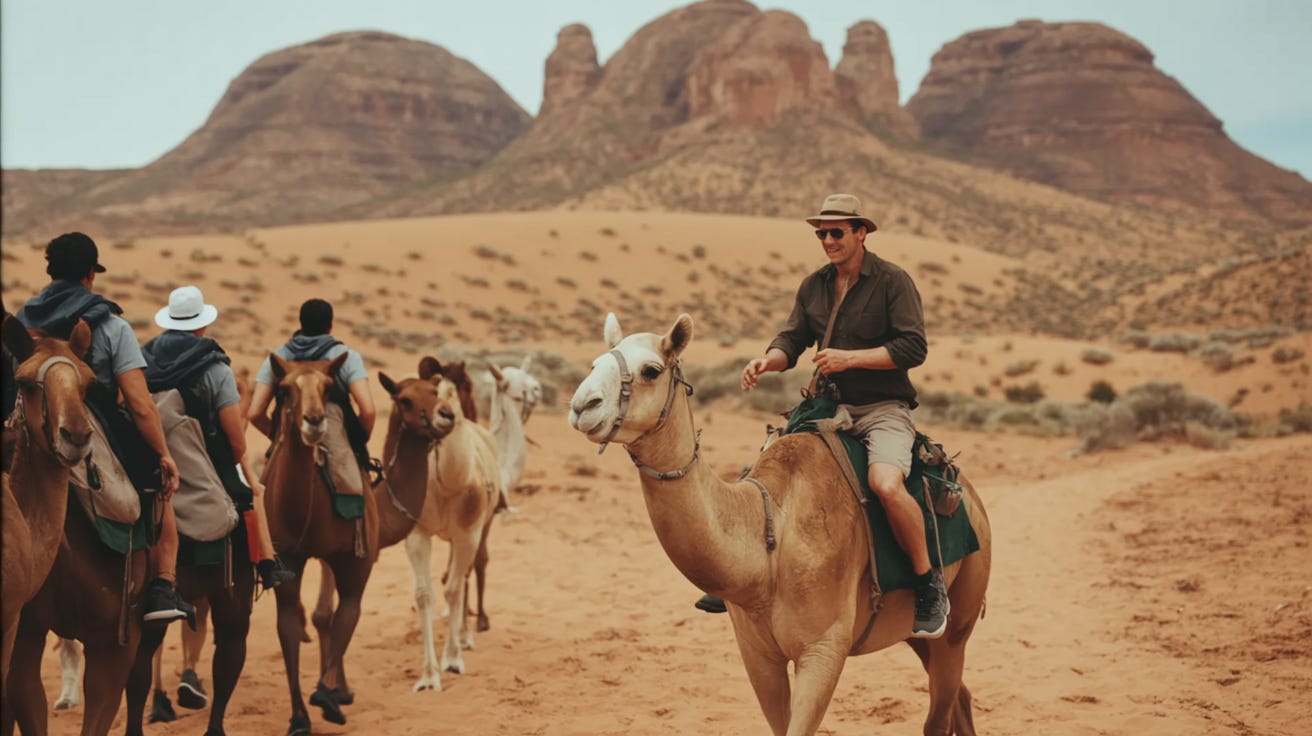
The afternoon provided a bit of frivolity when the entire group decided to ride camels. And this brings up an interesting story. During my journalism career I was assigned to spend three days in the California desert covering the conservation efforts of a group of hunters and several state agencies, who were erecting waterholes for desert bighorn sheep. I was flabbergasted to learn that the Anza-Borrego Desert State Park was home to feral donkeys, which had escaped custody from prospectors more than a century ago. This was the lead of my story: “People leave the strangest things in the desert.”
Well, folks left stuff in the Australian desert, too. Camels were introduced to Australia during the 1840s to support exploration and development across the bone-dry interior. Settlers realized that horses and steer were poorly suited to the deep sands and searing heat of the desert. Entrepreneurs imported the beasts from India, Afghanistan, and the Middle East, along with skilled Muslim cameleers who handled and cared for the animals.
By the 1920s, camels were replaced by motor vehicles and railways such as the Ghan Line (more on this in the next chapter), making their transport role obsolete. Many were simply released into the desert, where they thrived thanks to the open rangelands, scarce human presence, and absence of natural predators. Today, hundreds of thousands of feral camels roam central and western Australia.
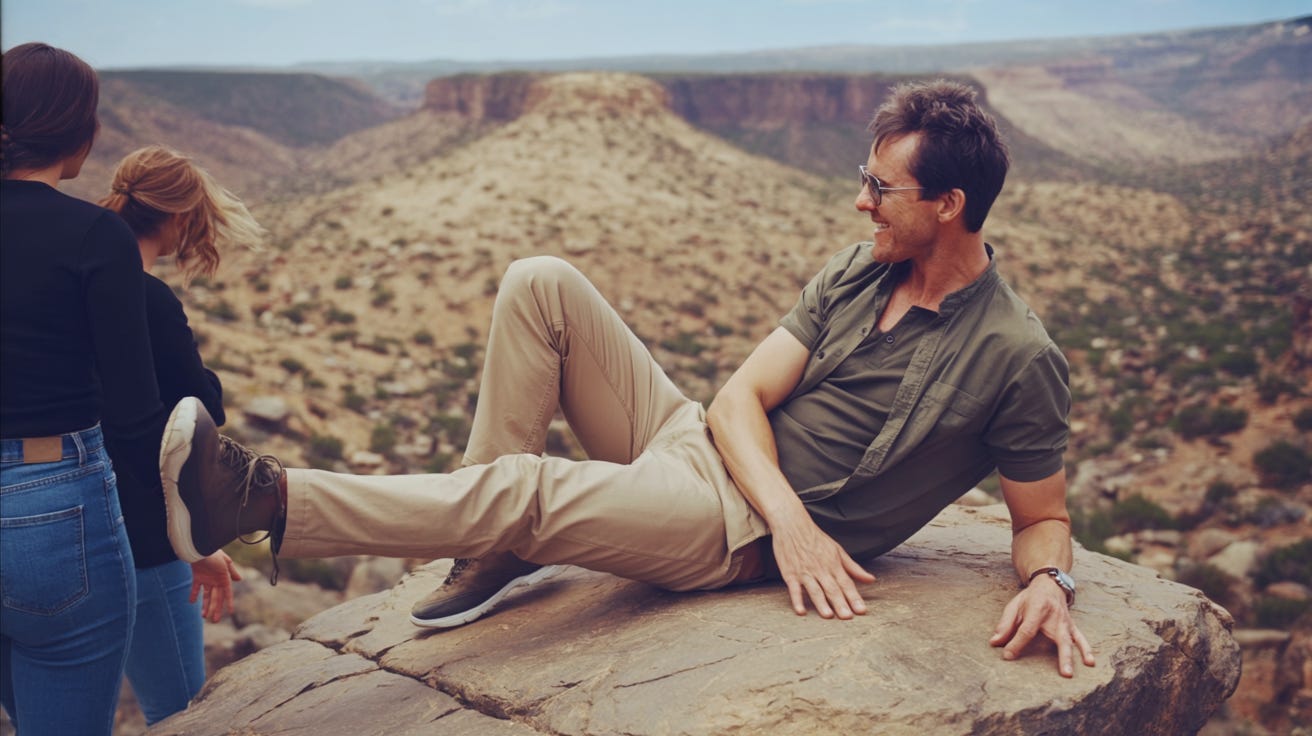
After our camel ride we returned to the campsite, where we sat around drinking (there is a market in town) while we waited for dinner. No shenanigans were to be had that night. We planned on getting up early to catch sunrise on the Olgas after the short drive back to a trailhead. The brochure for this tour showed us dramatic photos of a rock overlook called Karingaṉa Lookout and we all wanted to have our photo taken there.
Karingaṉa Lookout is the highlight of the Valley of the Winds trail, a relatively challenging five-mile hike between several of the towering domes. It features two primary lookout points — Karu Lookout and Karingaṉa Lookout — that offer spectacular open views over the red desert and rock formations. The rock platform at Karingaṉa gives hikers striking photo opportunities. It also requires great caution, as park rangers advise staying on the marked path and off the ledges for safety. I may not have stressed this in prior chapters, but the one thing (only?) I am afraid of is heights.
When we reached the lookout, I wormed my way between two of the gals, ready to use them as cushions should I fall, and then inched forward until my head extended beyond the edge of the rock, allowing me to peer down to my impending death 500 feet below. I took shallow breaths while gazing at the endless red desert that stretched, at least in my imagination, to the edge of the Indian Ocean, more than 600 miles to the west. Gracelessly, I reversed my crawl and found safety. The rest of the hike was uneventful.
We returned to our camp, sunburned and dehydrated. I and the gals had a wonderful meal of chicken, rice and beans. We exchanged stories and promises of staying in touch. The moon was only a thin, quarter slice in the crystalline sky, allowing me to see for the first and only time, the Southern Cross. Four stars form the distinctive cross shape, causing it to be used in this hemisphere for navigation by both Aborigines and Europeans, then later as decoration on both the Australia and New Zealand flags. The campfire emitted thin waves of heat that provided little relief from the cold desert so we headed to our tents. I knew I wouldn’t keep in touch, a practice I follow to this very day: Six continents, 50 countries, countless connections yet only one enduring friendship. I hadn’t even kept in touch with Livvy, who was my sweetheart - at least for two months.
As I laid my head to rest on a bundled jacket that served as my pillow, I wasn’t thinking about Livvy, the Olgas or Uluru. I was thinking about the next stage of my journey, a long ride aboard the Ghan, widely considered to be one of the 10 great train rides in the world.
Author’s note: This is the fifth entry in the section of my travel memoir that focuses on escapades in Australia. It follows the completion of part 1, called Interesting Ways to Die … in Africa, and part 2, Interesting Ways to Die … in South America. As usual, I will release new entries on a weekly basis until this section is finished. Read individual entries for the Australian section: #1, #2, #3 and #4.