


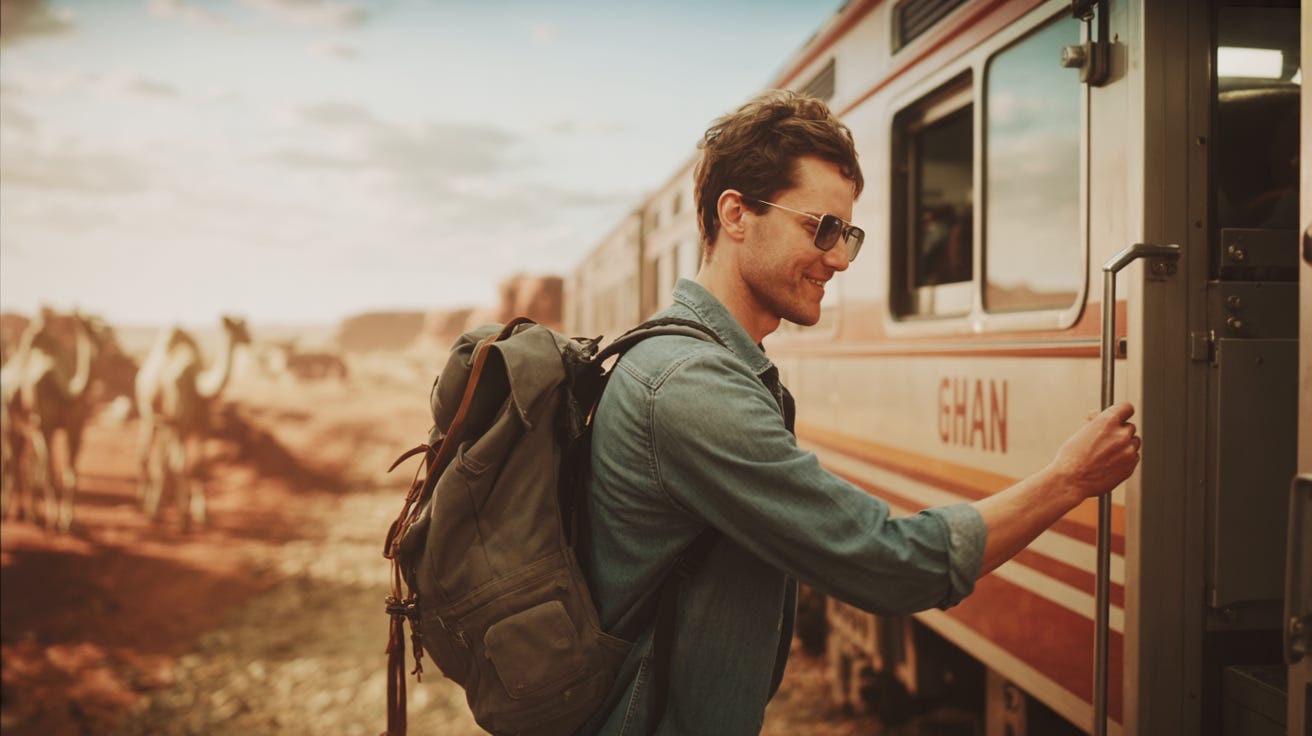
If you are a veteran reader of this travel memoir you surely remember my ride on the Lunatic Line, a railway built by the British from Mombasa to the shores of Lake Victoria in Kenya. It too is one of the great train rides of the world as judged by Lonely Planet travel guides. Construction on the Ghan began in 1878, inspired by the route taken by explorer John McDouall on his trek from Adelaide to Alice Springs, 969 miles away. That leg of the railway was completed in 1924. The second and final leg, from Alice Springs to Darwin, wasn’t finished until 2004.
I mentioned in the last entry that camels were introduced to Australia during the 1840s, along with skilled Muslim cameleers to handle them. The name “The Ghan” derives from “The Afghan Express,” honoring the Afghan cameleers who were instrumental in opening up Australia’s interior. In fact, these cameleers, along with their camels, played a significant role in supporting construction and maintenance of the line.
When we returned to Alice Spring after our visit to the Olgas, I walked over to the train station, a half-mile from the Todd Mall, to buy a ticket to Adelaide. I paid about $100 US for the right to share economy seating (no sleeper, no food, gruesome bathroom) with three other backpackers. I made sure that I could hop off near Coober Pedy, nearly half-way to Adelaide. Clarification: The Ghan doesn’t actually stop in Coober Pedy. Around dinner time, it dumps you in a tiny town called Manguri. You have to board a bus for the 25-mile ride into Coober Pedy.
Don’t pretend you know why I went to Coober Pedy — or even that you’ve heard of it. You haven’t. The reason I went there is actually pretty cute. This mining town came into being because a prospector found an opal there in 1915. The area was originally called the Stuart Range Opal Field before being renamed Coober Pedy in 1920. And this next historical nugget explains why I like to learn native place names. The name “Coober Pedy” can be translated into “white man in a hole” in the local Aboriginal language. You’ll understand in a minute.
It is ungodly hot and dry in the Outback. This area is no exception. The average daytime temperature in the summer is 98 °. I read a story, surely not apocryphal, in which the locals reported that birds fell from the sky due to heat stroke during one awful stretch of 120° days. Over the decades, the town became known for its unique way of coping with extreme summer temperatures. Many residents began living underground in “dugouts,” tunnels or cave-like homes bored into the rocky hills—a tradition that continues today and gives the town its memorable landscape and reputation.
Who could resist spending the night in a place that literally translates to “white man in a hole?” Beyond that, Coober Pedy is famous as the opal capital of the world, producing the majority of the planet’s precious opals from its vast mining fields. The second reason I wanted to visit? I wanted to buy my mom opal earrings, which became her favorite until her death in 2007. A romantic reader might suggest that I should have bought a pair for the girlfriend I planned on moving in with. Nope.
Upon arrival in town, I checked into the Coober Pedy Experience Motel, which began as an opal mine but was transformed into a motel in 1990. This establishment offered me an opportunity to sleep in an underground room carved from sandstone, equipped with modern amenities and a private bathroom that contained ceramic plumbing fixtures (not stone, much to my disappointment). It was not the most restful sleep I ever had, but what boy won’t make sacrifices for his mom? And hey, I got to be Fred Flintstone for 24 hours.
After breakfast, I bought the opal earrings then killed time until my bus ride back to the train station in Manguri, where I planned to hop aboard the Ghan and complete my journey to Adelaide, another 450 miles to the south. I don’t recall much from my wanderings around town, but I do remember that the Serbian Orthodox Church was my favorite spot. The complex comprises the church, a community hall, a parish house, and a religious school, all carved underground between 10 and 55 feet below the surface. The miners who built the church were part of a Serbian diaspora following World War II. People leave the strangest things in the desert, including themselves.
I boarded the train and found my seat, across from a young Australian couple who was wandering around the country on a white version of walkabout, their songlines etched in red marker on a well-worn map from the Australian Automobile Association. After exchanging greetings, I asked them what I should do when I got to Adelaide. They smiled and said there were two things to do in the city: Drink or go to church. They were not kidding.
South Australia, like the northeast coast of the United States before it, was colonized by fervent believers intent on establishing their own places of worship. Adelaide is known as the “City of Churches” because it has so many churches relative to its size. When I visited, there were 40 to 50 churches in the central business district alone. Most of the major flavors of Christianity were represented, including Anglican, Roman Catholic, Methodist, Presbyterian, and Baptist.
As you know, I have a soft spot for visiting cathedrals so I planned on exploring St. Peter’s Cathedral, even though it was Anglican, not Catholic. That said, my primary goal in visiting Adelaide was to track down my drinking buddies, Stephen and the Peters, and see if I could find a trace of Livvy.
We arrived at Keswick Terminal in the late morning. I bid farewell to my traveling companions and headed over to the tourist information center inside the terminal. Not sure if this still happens, but back in the day, most train stations had a tourist desk staffed by someone who could sniff out your budget, personality, and probable vices with a single glance. The middle-aged lady working the counter took one look at my dirty tee-shirt, cargo pants, and hiking boots and told me that she would find me a room along Hindley Street. I asked her why, and she just winked.
I learned later that Hindley Street played a dominant role in the city’s night life, and I, apparently, looked like the kind of guy who enjoyed entertainment best found after hours. Hindley Street, a little more than a mile from the train station, was close to Rundle Mall, which was and is the city’s core pedestrian shopping district. The main drag in Alice Springs is called Todd Mall and you now know the main drag in Adelaide is called Rundle Mall. When researching details to enliven my notes from this trip I learned that these streets are called “malls” because the term refers to a public area closed to most vehicle traffic and designed primarily for walking, shopping, and socializing. If you dig deep enough, you’ll learn that they are modeled after similar developments in the US and UK.
So, Hindley Street it was. I asked the lady if I would be staying in a hotel, hostel, or family-friendly B and B. She winked again while saying she had found me a room in a bar. I think I may be typecast.
Author’s note: This is the sixth entry in the section of my travel memoir that focuses on escapades in Australia. It follows the completion of part 1, called Interesting Ways to Die … in Africa, and part 2, Interesting Ways to Die … in South America. As usual, I will release new entries on a weekly basis until this section is finished. Read individual entries for the Australian section: #1, #2, #3 #4, and #5.